


British Columbia vs. Ontario: 5 Housing Law Differences Every Landlord Should Know
.png)
Co-Founder
Ontario and BC landlord laws differ vastly. Learn the five key rules every cross-border landlord must know before signing a lease.
Read More
Since 2020, the city of Ottawa has enacted multiple rental housing bylaws designed to preserve affordable housing, enhance rental property standards, and safeguard tenants. Following in the footsteps of Toronto and Hamilton, the city is now set to introduce a “renovictions” bylaw.
Housing affordability is a genuine concern, and some renters face real pressures in tight rental markets. Displacement can impact a person’s job stability, education, and mental health. However, the city has not demonstrated that “renovictions” are a significant problem in Ottawa, even though its position should be supported by clear statistical evidence.
Government data from the Landlord and Tenant Board (LTB), as well as insights gained from the city's consultations with tenant groups and housing and community legal groups, indicate that the issue is minimal. However, the city is using undocumented evictions, which are difficult to verify and measure, instead of depending on official government data for making decisions. The necessity of an additional bylaw remains unclear, given the city's awareness of the limited number of "renovictions”.
“Renovictions” is the slang term for bad-faith evictions in which a landlord seeks to evict, or has already evicted, a tenant under the pretext of repairs and renovations. This can occur with or without the landlord serving the tenant with an N13 notice. After serving an N13 to a tenant, the landlord may file an L2 application with the LTB to request an eviction. In both scenarios, the tenant is entitled to occupy their unit until the LTB hearing takes place and an eviction order is issued and enforced.
In the context of “renovictions”, bad-faith occurs when a landlord claims they need a unit vacant to complete extensive repairs or renovations but does not genuinely intend to carry out that work or is using that claim primarily to remove a tenant.
If a former tenant believes they were evicted in bad-faith under the pretense of repairs or renovations, they may seek recourse by filing a T5 application with the LTB. At a T5 hearing, an LTB adjudicator examines evidence to determine if the landlord acted in bad-faith and may award compensation to the tenant as stipulated in the RTA.
The city uses the term “undocumented evictions” to capture “instances where the N13 notice is never issued to the tenant in the required form, or is issued and never filed with the Landlord and Tenant Board (LTB)”. This definition should exclude cases where tenants are served N13 notices, as these are documented and do not always result in evictions. Additionally, tenants who decide to move after receiving an N13 notice, but before an LTB hearing, are acting within their rights under the Residential Tenancies Act (RTA). They should not be labelled as "renovicted" unless they file a T5 application and the LTB concludes that their eviction was carried out in bad-faith.
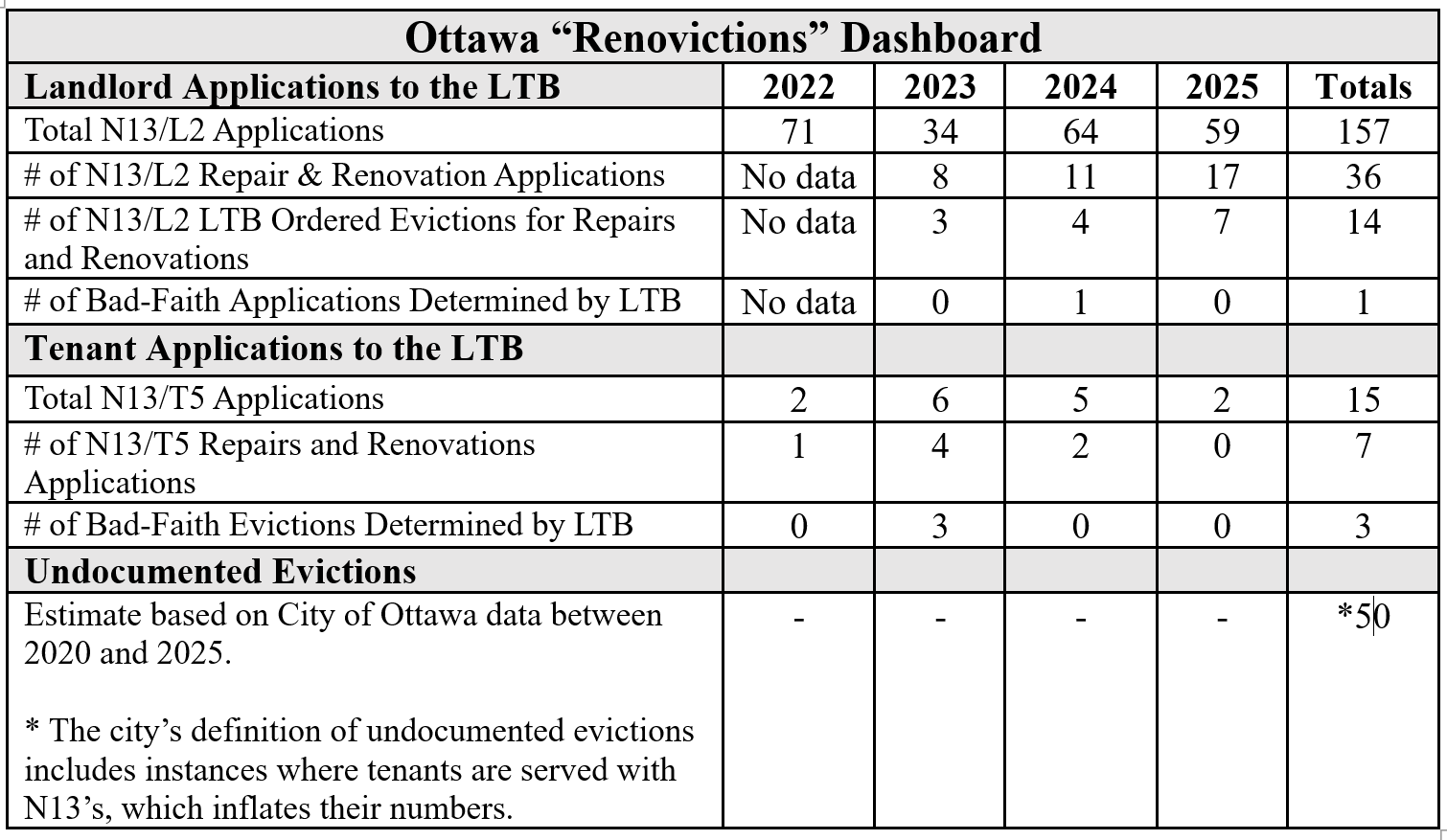
The N13/L2 and N13/T5 data presented in Table 1 below were obtained from the LTB through two Access to Records requests. The information about undocumented evictions is from the city’s Engage “Renoviction” website.
- 157 total applications over four years.
- Only 36 were for repairs/renovations.
- 14 LTB eviction orders were issued for repairs/renovations.
- Only 1 was found to be bad‑faith (this number could change as some 2025 hearing outcomes are still pending).
- 15 total applications over four years.
- Only 3 confirmed bad‑faith cases.
- City estimates ~50 undocumented eviction cases since 2020, a low number.
- The city’s estimates include instances where tenants received N13s which inflates their numbers.
- These are difficult to verify and confirm.
- The RTA rules discourage landlords from seeking N13 evictions.
- Most landlords defer repairs and renovations until tenants move out naturally.
- N11 mutual agreements are sometimes used instead of N13s.
- Former tenants may not be aware that they can file T5 applications or they find the process too onerous to go through.
Table 1 – Ottawa “Renovictions” Dashboard – 2022 to 2025
Provide feedback on this article by sending an email to tjmiller174@gmail.com




Tony Miller is an Investor Focused Realtor and landlord in Ottawa. He is an active stakeholder in Ottawa’s housing and rental housing bylaw matters.




.png)

.png)

.png)















.png)


.png)
.png)

.png)


.png)


