
Made for: Landlords or housing providers, property managers
Length: 6 minutes and 14 seconds
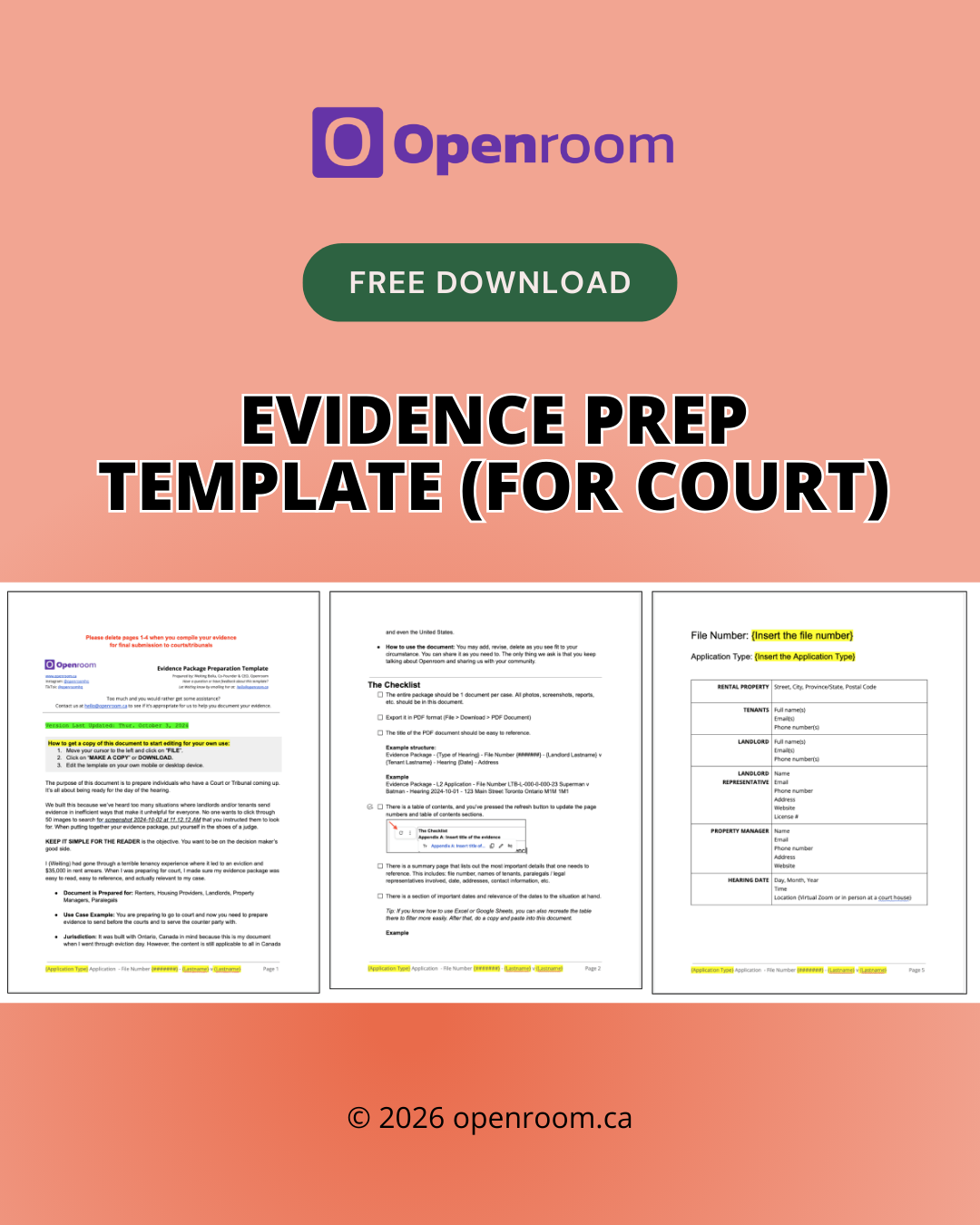
In the case you end up in court, our evidence prep template is a free resource that might be helpful for you.
When rent doesn’t show up on time, it’s tempting to flick on your “mean landlord” hat, but a structured, documented approach works better and is legally safer.
I'm Weiting - CEO and co-Founder of Openroom. After losing $35K+ from tenants who didn't pay rent, I've spent a few thousand hours dissecting the rental compliance laws of Canada to share knowledge I wish I knew about rental housing to prevent you from repeating my mistakes.
I've spoken to thousands of housing providers and residents - one can say I'm a little more than obsessed about everything in this realm. I breathe, sleep, and dream about Openroom - the future to a transparent and connected rental ecosystem.
Let's dive into non-payment of rent shall we?
Here’s a playbook:
The day after rent was due, reach out. A simple email or phone call saying, “Hey, I didn’t see your payment come in, is everything okay?” can make a big difference. Sometimes life happens, and a friendly nudge avoids escalation.
If rent is due monthly on the 1st, you can start serving on the 2nd. Some people wait but it's recommended to serve the N4 Notice by the 4th of the Month at the Latest
If rent is still unpaid, issue a Notice to End a Tenancy Early for Non-Payment of Rent (Form N4). The LTB requires this formal notice.
If the termination date has passed and the tenant hasn’t paid or moved, file Form L1 Application to Evict a Tenant for Non-Payment of Rent and to Collect Rent the Tenant Owes.
Even after filing, try to negotiate. The LTB encourages good-faith repayment offers.
At the hearing, present your evidence: your N4, service proof, the rent ledger, any payment-plan offer, communications, and more. Put it into your evidence package. My team's made an evidence template you can download and use for free.
As soon as you get the order, upload it to OpenRoom. OpenRoom lets landlords share the decision and debt with other landlords for transparency.
Report the debt for credit reporting, even if the tenant hasn’t physically left yet. This helps enforce accountability.
Getting the order is one thing, enforcing it is another. If the tenant doesn’t leave or doesn’t pay, there are five enforcement options you can explore Garnishment, Examination Hearing, Writ of Seizure/Sale, and more through Small Claims Court. You can also list the debt with a Collection Agency; you have options!
Keep pushing until you recover what is owed.
That way, even if eviction is your last resort, you've built a legally sound case, and you’ve shown you gave the tenant every fair chance.
Disclaimer: The information provided in this article is for general educational and informational purposes only and does not constitute legal, financial, or professional advice. You should consult a qualified professional regarding your specific circumstances before taking any action.
.png)



Weiting's entrepreneurial journey began with a costly lesson in rental property management, where she experienced losses exceeding $35,000 due to non-paying tenants. Determined to prevent others from facing similar challenges, she built Openroom to pave a future towards a transparent and connected rental ecosystem.
Drawing from her extensive background in software product management spanning education, telecommunications, insurance, and artificial intelligence, Weiting has become a trusted advisor to founders of venture-backed companies. Beyond the tech sphere, Weiting managed properties for over a decade and made significant contributions to community leadership. She’s served on the Board of Rotary District 7070 and chaired various organizational committees.
Weiting balances her professional endeavours with being a parent of two kids under two. Alongside thousands of other parents, she was awarded participation trophies in innovative improvisation, ever-changing expectations management, daily roadmap planning, and hardcore patience!


.png)
.png)
.png)
.png)
.png)
.png)

.png)
.png)