Made for: Landlords or housing providers, property managers
Length: 5 minutes and 36 seconds
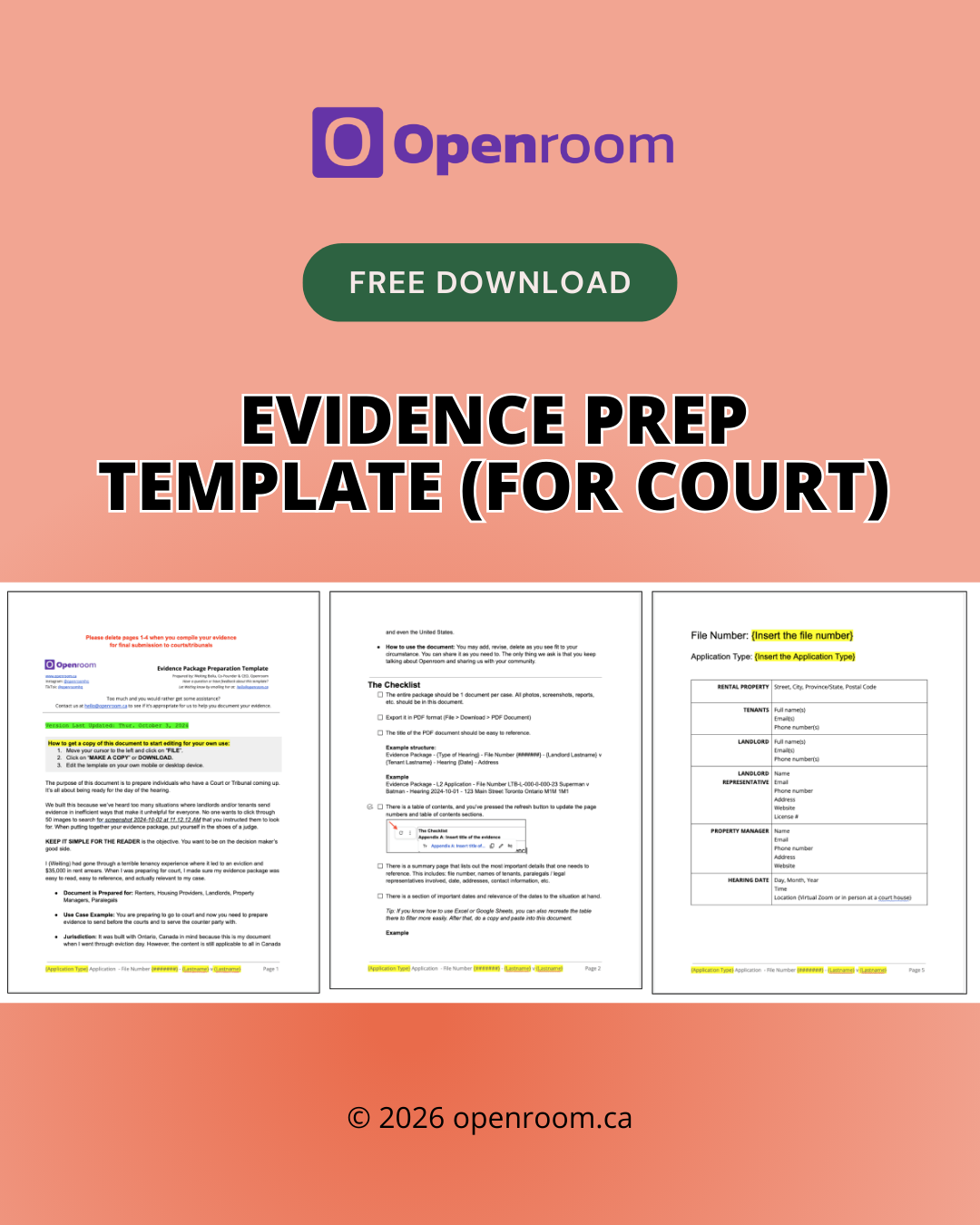
In the case you end up in court, our evidence prep template is a free resource that might be helpful for you.
If you’re a landlord in Ontario, understanding rent control feels a bit like understanding my mood swings when I was a teenager. In this video, I’ll be walking through the four different ways rent can increase: when a unit is rent controlled, when rent control doesn’t apply, when to use above the guideline increases, and when increase by agreements.
My name is Weiting Bollu. I’m the CEO and co-Founder of Openroom.ca - where my team aggregates court orders from across Canada as it relates to residential tenancy, and we make it searchable for you to make more informed decisions of who you rent to and who you rent from.
This movement towards a transparent and connected rental ecosystem is based on my experience of losing over 35K to tenants who didn’t pay rent - yes, you can judge and laugh at me. It was painful financially, mentally, and emotionally. I believe in a world of education and that’s where Openroom University comes in where I share knowledge I wish I knew with you.
Ok, let’s dive in shall we?
Under the Residential Tenancies Act, 2006 (RTA), some units are rent-controlled and others are rent-control-exempt, and the difference can determine whether your rent increase is perfectly legal or destined to be rejected by the Landlord and Tenant Board before it ever gets off the ground.
What’s rent control? It’s where your landlord can’t raise your rent “too much”. Your rent can go up a little, not a lot. It usually goes up once a year. The government decides how much is allowed.
It exists because it helps people stay in their homes and to stop surprise rent jumps that people can’t afford. It usually only applies to older homes. Newer homes often don’t have rent control.
—
In Ontario, most units are first occupied on or before November 15, 2018 will fall under rent control. For these, the landlord can only raise rent up to the annual guideline set by the prnce ovi(RTA s.120). The next year’s allowable increase percentage is released on the Ontario government’s website before August 31st of the prior year.
Units first occupied after November 15, 2018 are exempt from the guideline (RTA s.6.1.) This includes new builds, new basement apartments, and shiny conversions. Here, the landlord can raise rent by any amount, but must still follow two rules:
—
This is the classic “annual rent bump” allowed under the RTA. The province announces the percentage, you use Form N1, give 90 days’ notice, and hope the tenant doesn’t accuse you of personally causing inflation.
If your unit qualifies (under s.6.1) as rent control exempt, you can raise the rent by any amount, using Form N2. Same timing rules apply, 12 months since the last increase, 90 days’ notice.
Yes, you can raise it by 20%, but should you? That’s a question for you.
Under RTA (s.126), landlords of rent-controlled units can apply for an AGI if:
Above-guideline increases exist to cover major capital expenses, allowing landlords to recover the cost of necessary long-term repairs, such as roofing or structural work, that can’t be absorbed through regular rent increases.
The LTB limits most AGIs to 3% above the guideline per year.
If you’re interested, I hosted a webinar with a Paralegal on AGIs! Check in the description.
Under RTA (s.121), landlords and tenants can mutually agree to a higher increase, usually to pay for improvements or extra services. Just remember, the tenant gets five days to change their mind, like a cooling-off period in case that “nice upgrade” didn’t turn out to be worth the extra rent.
Okay, time for our Rental Trio: the top 3 takeaways for this video.
Whether your unit is rent-controlled or exempt determines what increases you can apply and how far they can go. Use the correct RTA section, the right form, and proper notice to do it properly.
Disclaimer: The information provided in this article is for general educational and informational purposes only and does not constitute legal, financial, or professional advice. You should consult a qualified professional regarding your specific circumstances before taking any action.
.png)



Weiting's entrepreneurial journey began with a costly lesson in rental property management, where she experienced losses exceeding $35,000 due to non-paying tenants. Determined to prevent others from facing similar challenges, she built Openroom to pave a future towards a transparent and connected rental ecosystem.
Drawing from her extensive background in software product management spanning education, telecommunications, insurance, and artificial intelligence, Weiting has become a trusted advisor to founders of venture-backed companies. Beyond the tech sphere, Weiting managed properties for over a decade and made significant contributions to community leadership. She’s served on the Board of Rotary District 7070 and chaired various organizational committees.
Weiting balances her professional endeavours with being a parent of two kids under two. Alongside thousands of other parents, she was awarded participation trophies in innovative improvisation, ever-changing expectations management, daily roadmap planning, and hardcore patience!


.png)
.png)
.png)
.png)
.png)
.png)

.png)
.png)