Made for: Renters, property managers
Length: 7 minutes and 53 seconds
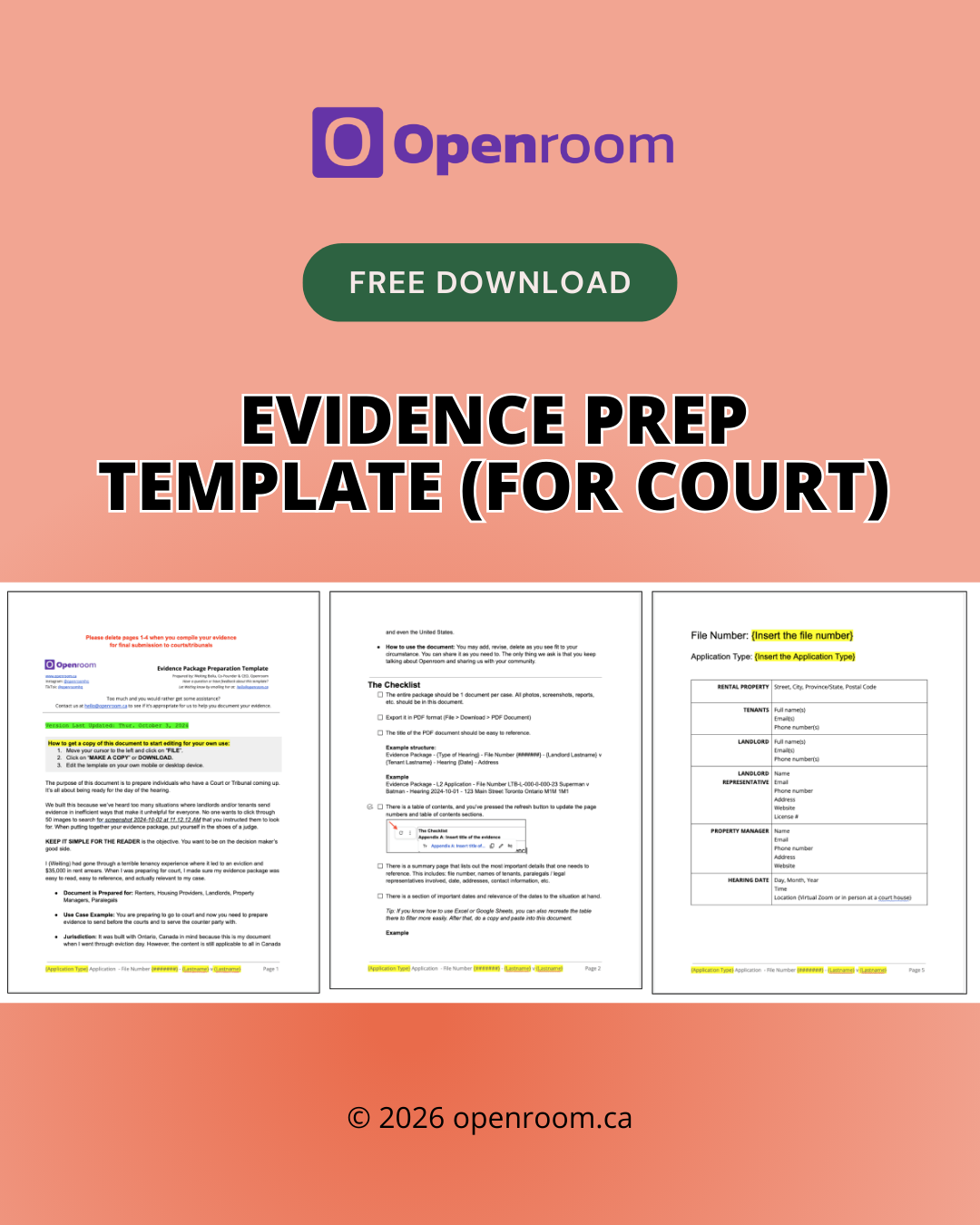
In the case you end up in court, our evidence prep template is a free resource that might be helpful for you.
I can’t just pay my rent and expect to live in peace?
What’s the RTA? LTB? RHEU? SCC?
In this video, I tell you what you need to know to ensure you are protecting yourself as a tenant in Ontario.
Hi - I’m Weiting Bollu. I’m the CEO of Openroom.ca where we aggregate tenancy court orders across Ontario and make that information accessible across the financial ecosystem to support accountability and transparency. You should know who your renting from - like does that landlord take care of maintenance? That’s what you’d search for on Openroom.
The thing is, I purchased my first property at 23. But prior to that, I lived in student housing at York University and I rented from private landlords over the summer during internship days. I didn’t know about these acronyms or why it was even needed.
Now with Openroom University, I’m bringing you knowledge of I wish I knew so that you don’t make mistakes like I did.
—
Ontario’s residential tenancy compliance is based on the Residential Tenancies Act also known as the RTA for short. (RTA). It’s a provincial law that governs rental housing, defining rights and responsibilities for tenants and landlords.
In Ontario, the lease is just the beginning. Once the keys are handed over to you, the landlord is now governed by everything that’s written in the RTA. On your side, it also specifies what is your responsibility vs. what’s the landlord’s responsibility.
If they write clauses in your lease that contradicts what’s in the RTA, the RTA is king. For example, many will write clauses such as “you can’t have pets in the unit” but if you move in and later on want a pet, then you’re allowed per the RTA to have one.
Two caveats:
When landlords are unhinged and do weird things that you might find as crossing boundary lines, your job is to stay calm, factual, and boring.
The Landlord and Tenant Board (LTB) is an administrative tribunal that resolves disputes between residential landlords and tenants, handling issues like evictions, rent payment problems, and maintenance complaints, governed by the Residential Tenancies Act.
They are similar to court with the ability to issue decisions or judgements, but they are not an official “court”.
When your landlord is threatening you with eviction or lockouts, remember that “boring” style from earlier? It can help you win at the LTB. Do we see a lot of very emotional cases, yes. The last thing you want is to be labelled and known as a “professional tenant” for taking advantage of the system.
If behaviour escalates into further threats or harassment, call the police.
Will they solve the tenancy issue? Rarely.
Will they create a paper trail that shows you acted responsibly? Absolutely—and that paper trail can be gold later. You want evidence showing that you acted professionally when you bring the dispute to the LTB.
____
Another underused resource is the Rental Housing Enforcement Unit (RHEU). You can contact them to try to resolve issues before you take matters to the LTB. They won’t rush in like superheroes, but occasionally, they do show up.
Because often times, we don’t want issues to escalate into the tribunals or courts. Going further may have potential consequences such as court orders being publicly accessible under Canada’s Open Court Principle.This means others can see your dispute.
When you file a complaint with the RHEU, have these pieces of information ready:
If you call in, you may also want to write a letter OR an email so you have it on record.
You should also:
The Small Claims Court comes in handy as it handles post-tenancy financial claims (e.g. win of bad faith evictions, win of rent abatements) and enforces LTB orders for money.
Yes that's right, the paper you got from the LTB doesn't actually do much just yet....
unless you're using Openroom's rental debt ledger to negatively impact the credit history of your landlords (the Debtors). Yup, my team can help you connect into Equifax!
More on that in the description below. But I sidebar. Let’s get back.
Sometimes, you want to go further so you’d go for enforcement methods such as seizure of property after an LTB order to try to get money back.
Okay, it’s time for our rental trio: the top 3 takeaways of this video.
Speaking of which, I’ve got a template on what an evidence package could look like. Download it for free to prepare for the LTB if you end up there.
If you found this helpful - please share with another renter to make sure they know the basics. Send me some questions in the comments, or hit subscribe to this channel to stay in the loop.
Thanks for watching and I’ll see you next week!
Disclaimer: The information provided in this article is for general educational and informational purposes only and does not constitute legal, financial, or professional advice. You should consult a qualified professional regarding your specific circumstances before taking any action.
.png)



Weiting's entrepreneurial journey began with a costly lesson in rental property management, where she experienced losses exceeding $35,000 due to non-paying tenants. Determined to prevent others from facing similar challenges, she built Openroom to pave a future towards a transparent and connected rental ecosystem.
Drawing from her extensive background in software product management spanning education, telecommunications, insurance, and artificial intelligence, Weiting has become a trusted advisor to founders of venture-backed companies. Beyond the tech sphere, Weiting managed properties for over a decade and made significant contributions to community leadership. She’s served on the Board of Rotary District 7070 and chaired various organizational committees.
Weiting balances her professional endeavours with being a parent of two kids under two. Alongside thousands of other parents, she was awarded participation trophies in innovative improvisation, ever-changing expectations management, daily roadmap planning, and hardcore patience!


.png)
.png)
.png)
.png)
.png)
.png)

.png)
.png)