
This video is brought to you by Openroom with our partners at Courtready.ca. They build practical tools and lessons for self-represented litigants across Canada.
Made for: Landlord, Tenants, and anyone in the rental industry
Length: 9 minutes 13 seconds
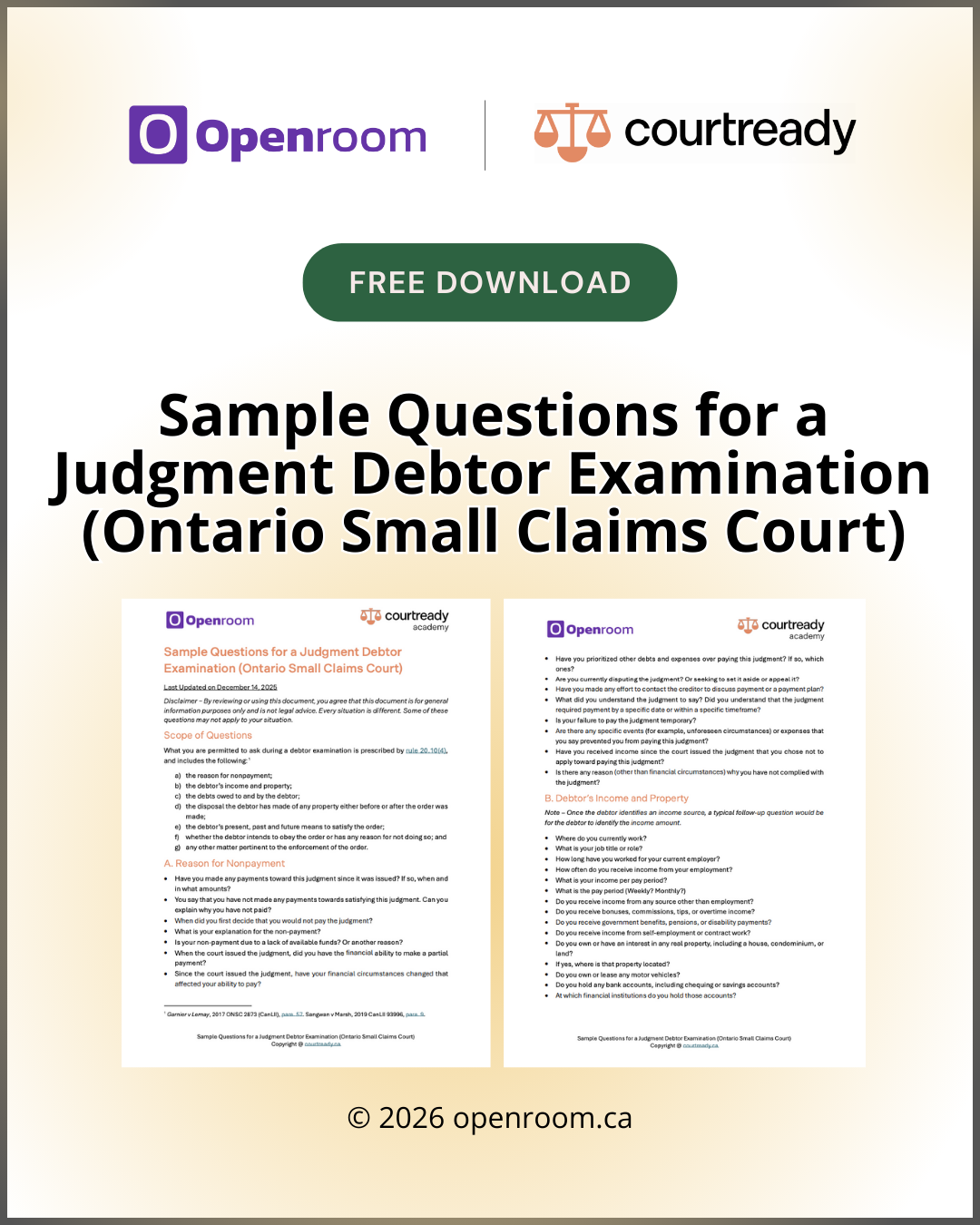
What is your explanation for the non-payment? Where do you currently work? Can you explain why you have not paid? What is your income per pay period? Do you own property - where is it located? Do you own or lease motor vehicles?
Hello, my name is Weiting Bollu, and I’m the CEO of Openroom.ca.
Today’s video is made in partnership with Courtready.ca, which builds practical tools and lessons for self-represented litigants across Canada.
In this video, I’m going to walk you through debtor examinations under Ontario’s Small Claims Court Rules. This is one of the most important, and often misunderstood, enforcement tools available after you’ve already won your case.
Honestly, I wish I had this no-nonsense Q&A when I took my former tenants who decided not to pay rent of over $35,000 for an examination hearing. Well, it’s never too late to learn. I’m sharing knowledge with you so you can make more informed decisions.
Here we go.
A debtor examination is a court-supervised process that happens after you have a judgment - but the debtor has not paid. Example is an LTB order that states landlord owes tenant money or the tenant owes landlord money.
Winning your case is only step one. If the other side doesn’t pay voluntarily, you will need information to help you enforce the judgment. Information like:
A debtor examination gives you a structured, legal way to get those answers.
Before you start, you have to familiarize yourself with (Rule 20.10) Ontario’s Small Claims Court Rules. Under this rule, you can request a debtor examination if there is a default under an order for payment or recovery of money.
In practical terms, that means:
If those conditions are met, you can request the court clerk in the courthouse closest to where the debtor lives or carries on business to issue (i.e., “sign”) a completed Notice of Examination. This is Form 20H. Now, the Rules actually require the court clerk to issue this document, as long as you have completed the form properly.
To successfully cause the court clerk to issue this document, you must file three key documents:
First, an Affidavit for Enforcement Request, which is Form 20P. This affidavit sets out:
Second, if your judgment was made in a different territorial division, you must also file a Certificate of Judgment, which is Form 20A. This means if you received the Judgment in Toronto, but the debtor lives in Ottawa, you will need to complete Form 20A and file this document along with your affidavit (Form 20P).
Third, the actual Notice of Examination (Form 20H) itself. You need to contact the court clerk in the territorial division where the debtor lives to decide on a time and date for the court to hold this examination. Once you have this information, include it in Form 20H.
Once the court clerk accepts your filing, you will receive an “issued” (or “signed”) copy of the Notice of Examination. The issued copy of the Notice of Examination will have the date and time of the examination.
Service is always critical. Once you have your issued copy of the Notice of Examination, you must serve this document in compliance with Rule 8.
In most cases, this means personal service under Rule 8.02 or an alternative to personal service under Rule 8.03.
If the debtor is an individual, you must also serve a blank Financial Information Form, which is Form 20I, at the same time.
Timing really matters here. The issued copy of the Notice of Examination must be served at least 30 days before the examination date. And this document must be filed with proof of service (like an affidavit of service) at least three days before the hearing.
If the service is defective, the examination may not proceed.
This is where debtor examinations are powerful.
The debtor can be examined under oath about:
In short, the examination is about gathering financial information from the debtor, so that it becomes easier to enforce the judgment.
Our friends at Courtready.ca have also prepared a document containing sample questions you can review. Remember – each situation is different. Some questions may not apply to your situation.
Debtor examinations are not optional.
The Rules require that a person served with a Notice of Examination must inform themselves about the issues being examined, and be prepared to answer questions.
If the debtor is an individual, they must complete Form 20I, the Financial Information Form, serve it on the creditor before the hearing and bring supporting documents, like pay stubs or bank statements, to court.
This information is not filed publicly, but it is reviewed by the judge.
If the debtor is a corporation, partnership, or sole proprietorship, the Rules allow someone to be examined on its behalf. For a corporation, this can be an officer or director. For a partnership or sole proprietorship, this can be a partner or the sole proprietor.
Debtor examinations are private (unless the court orders otherwise). They are conducted under oath and are recorded. The debtor has a legal obligation to answer honestly. This is a formal court process. False or misleading answers can have serious consequences.
After the examination, the court may make an order specifying payment terms.
This could include a payment schedule, specific payment dates or other structured enforcement directions.
Importantly, while an order as to payment is in force, most other enforcement steps are paused, with limited exceptions. This is meant to create clarity and structure, not chaos.
If you’re going to do-it-yourself, you might find it extremely helpful to get prepped with questions. In partnership with Courtready.ca, we’ve made a list of some of the questions you could ask during your examination hearing. Check the comments and download it for free.
—-
Alright - time for the rental trio recap:
But remember, everything I share with you is for education purposes only. Consult a legal professional to assess your situation.
If you found any of this information helpful, let me know in the comments. Hit subscribe and I’ll see you next week for more Openroom University knowledge share.
Disclaimer: The information provided in this article is for general educational and informational purposes only and does not constitute legal, financial, or professional advice. You should consult a qualified professional regarding your specific circumstances before taking any action.
.png)



Weiting's entrepreneurial journey began with a costly lesson in rental property management, where she experienced losses exceeding $35,000 due to non-paying tenants. Determined to prevent others from facing similar challenges, she built Openroom to pave a future towards a transparent and connected rental ecosystem.
Drawing from her extensive background in software product management spanning education, telecommunications, insurance, and artificial intelligence, Weiting has become a trusted advisor to founders of venture-backed companies. Beyond the tech sphere, Weiting managed properties for over a decade and made significant contributions to community leadership. She’s served on the Board of Rotary District 7070 and chaired various organizational committees.
Weiting balances her professional endeavours with being a parent of two kids under two. Alongside thousands of other parents, she was awarded participation trophies in innovative improvisation, ever-changing expectations management, daily roadmap planning, and hardcore patience!


.png)
.png)
.png)
.png)
.png)
.png)

.png)
.png)