
.png)
Made for: Renters, Housing Providers, and anyone in the rental industry
Length: 11 minutes and 13 seconds
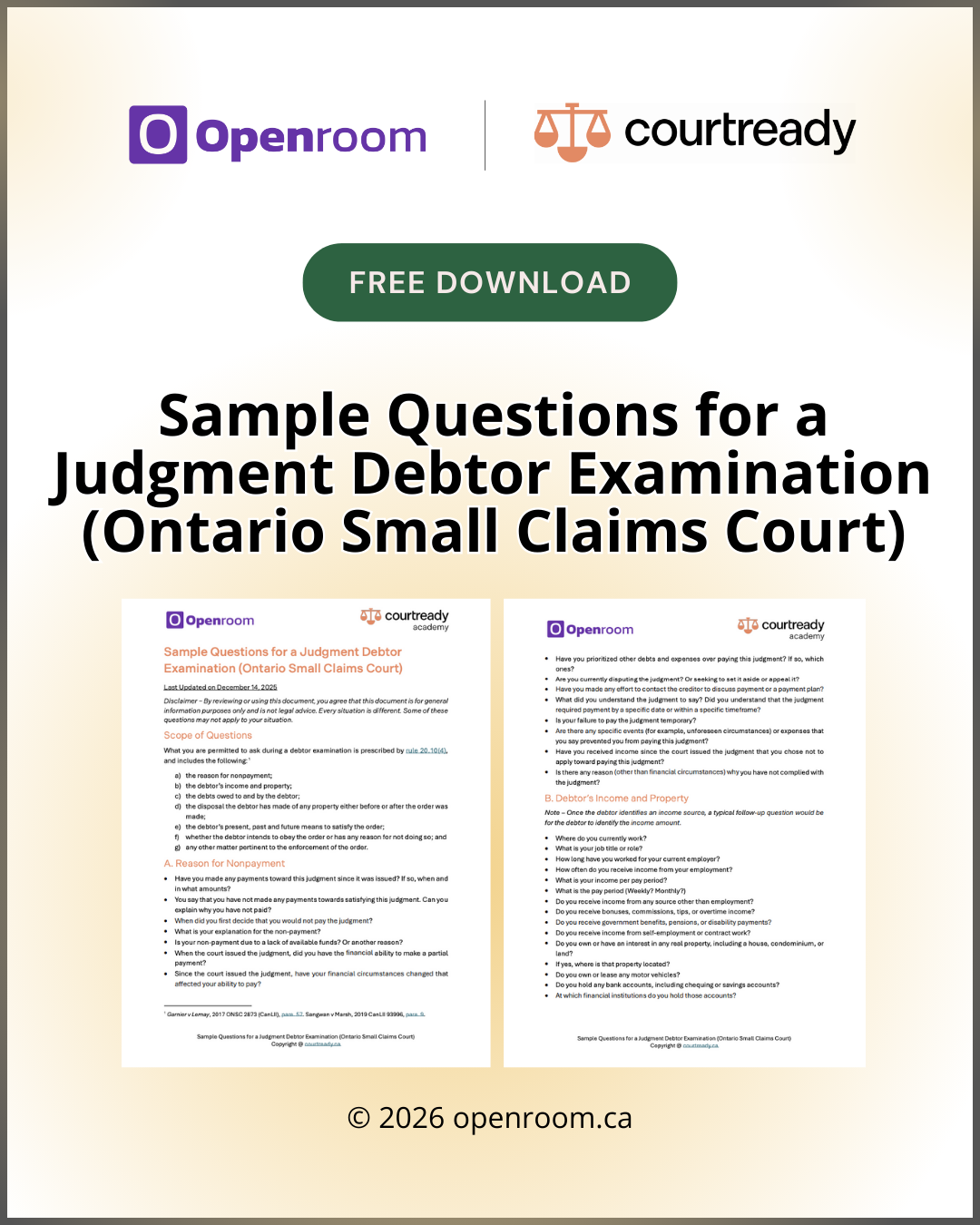
Hello, my name is Weiting, and I’m the CEO of Openroom.ca. Today’s video is made in partnership with Courtready.ca, which builds practical tools and lessons for self-represented litigants across Canada.
If you’ve used Openroom, there’s a good chance you’ve been through this exact pattern. Maybe you’re a landlord with an order for unpaid rent or damages. Maybe you’re a tenant with an order against a landlord, for things like a refund of rent, an illegal eviction, or interference with your reasonable enjoyment of the unit. Either way, you went to the Landlord and Tenant Board, you got an order for money, and then you converted it into a Small Claims Court judgment because the money still wasn’t coming.
So now, on paper, you have a judgment. The court has said you are owed the money. But the money still isn’t coming. Today’s video is about one of the most misunderstood tools in that process: contempt of court in Small Claims Court. I want to walk you through it the way the Rules actually lay it out, step by step, so you can see what your options really are. I’ll also be straight with you upfront. Contempt of court is not a magic wand for forcing the other side to pay. The law is actually pretty clear on that point, and I’ll come back to it. But contempt does still have a role in the enforcement process, and understanding that role is the difference between using the system effectively and burning months of your time chasing the wrong remedy.
Let’s start with the step that comes first, because contempt in Small Claims Court is almost never a standalone thing. It’s a consequence of something else. Under Rule 20.10 of the Rules of the Small Claims Court, when there’s default under a money order, you can ask the court clerk to issue a Notice of Examination. That’s Form 20H. The notice gets served on the debtor and, in plain terms, requires them to come to court and answer questions under oath about their finances. What can they be examined on? Quite a lot, actually. The reason for non-payment. Their income and property. The debts they owe and the debts owed to them. Any property they’ve disposed of, before or after the order was made. Their past, present, and future means to satisfy the order. Whether they intend to obey, and any reason they might have for not doing so. And any other matter pertinent to enforcement. [Consider referring to prior video?] If the debtor is an individual, they also have to fill out a Financial Information Form. That’s Form 20I. They have to serve it on you. They have to give a copy to the judge. And they have to bring documents to back up what they put on the form. The examination itself is held in private, unless the court orders otherwise. It’s conducted under oath. And it’s recorded. That’s the examination. So what happens if the debtor doesn’t cooperate? That’s where Rule 20.11 comes in.
Rule 20.11 is where contempt enters the picture. It works like a sequence.
There are exactly two ways a contempt hearing can be ordered. Either the debtor was served with the Notice of Examination, showed up, but refused to answer questions or produce documents. Or, the debtor was served and just didn’t show up at all. If neither of those things has happened, you’re not in contempt territory yet.
If one of those triggers is met, the court can order the debtor to appear at a contempt hearing. The clerk of the court provides you with a Notice of Contempt Hearing, which sets out the time, date, and place of the hearing.
This is your job as the creditor. You have to serve the Notice of Contempt Hearing on the debtor, and you have to file proof of service at least seven days before the hearing date. Don’t miss this. If service isn’t done properly, the contempt hearing can fall apart before it starts.
The Rules give the debtor a chance to defuse this before the hearing. Under subrule 20.11(4), the debtor can bring a motion, in other words, a formal request, to set aside the order for the contempt hearing. They can do that before or after they receive the notice, but they have to do it before the hearing date itself. If the court grants the motion, the contempt hearing doesn’t go ahead. Instead, the debtor is ordered to attend a fresh examination. Note that this applies only to a debtor who failed to attend the examination, not to a debtor who showed up but refused to answer questions.
So in some cases, the threat of a contempt hearing is enough to get the debtor to come back in for an examination. That alone can be useful.
If the matter does go ahead, the court takes contempt seriously, and what happens at the hearing depends on which track the debtor is on. If the debtor is there because they showed up to the examination but refused to answer questions, the framework is what's called show-cause. That just means the burden is on the debtor to explain why they shouldn't be held in contempt. If they can't give the court a good reason, the court can find them in contempt. If the debtor is there because they didn't show up to the examination at all, the hearing is governed by section 30 of the Courts of Justice Act, which sets out its own requirements the court has to be satisfied of.
Either way, contempt is treated as a serious matter. Courts have consistently said the case has to be proven beyond a reasonable doubt, the same kind of standard you'd see in a criminal trial, and any doubt is resolved in the debtors favour.
If the court is satisfied, subrule 20.11(7) gives the judge four options. The judge can order the debtor to attend a fresh examination under Rule 20.10. The judge can jail the debtor for a period of not more than five days. The judge can order another contempt hearing on a future date. Or the judge can make any other order the judge considers necessary or just. So jail is one of four options. It is not the default. And the maximum is five days.
If the judge does order jail, the actual paperwork that gets issued is called a Warrant of Committal. The form is Form 20J. I want to spend a minute on this form, because if your matter ever gets here, it’s worth understanding what it actually says. The warrant is addressed to all police officers in Ontario, and to the officers of all correctional institutions in Ontario. So it’s not directed at one particular police service. Any police officer in the province has authority under the warrant.
The body of the warrant identifies the debtor by name. It then checks one of two boxes, mirroring the two triggers we covered in Step 1. Either the debtor wilfully failed to attend the examination hearing as required by a Notice of Examination that was properly served. Or, the debtor attended the examination hearing, refused to answer questions or produce documents or The warrant then states the number of days the debtor is to be detained. And it directs the police to take the person to the nearest correctional institution and admit them. You as the creditor can also fill out an Identification Form, that’s Form 20K, to help the police actually find the debtor. That’s optional, but practically useful.
The warrant is in force for twelve months from the date of issue. After that, it expires. But it can be renewed for another twelve months at each renewal, by order of the court on a motion you bring as the creditor.
If the debtor is taken into custody, they’re discharged either when the time on the warrant expires, or by an order of the court, whichever comes first. That is Rule 20.11 from beginning to end.
I told you at the start I was going to be straight about what contempt can and cannot do. Here’s the part I want you to remember most. Contempt of court in Small Claims Court is about the debtor’s conduct in the examination process. It is not about whether they have actually paid the judgment.
So if your debtor just won’t pay, that on its own is not enough. You have to be able to point to conduct in the examination process. That’s the doorway. Remember: Rule 20.11 is a tool for dealing with debtors who refuse to engage with the examination process. It is not a tool for collecting money.
So let me put this in plain terms. If the other side won’t pay your Small Claims judgment, contempt is not the tool that will make them pay. The law doesn’t allow it to be used that way. What contempt can do is enforce the examination process. If you serve a debtor with a Notice of Examination and they don’t show up, or they show up but won’t answer, that’s where contempt actually has teeth. Practically, the realistic uses of contempt for a creditor, whether you’re a landlord, a tenant, or anyone else who has converted an LTB order into a Small Claims judgment, look like this.
One. It can bring a debtor to the table. Sometimes the threat of a contempt finding is enough to produce a structured payment plan, or to get the debtor to actually show up and answer questions.
Two. It can keep the file alive. Even when a judge is skeptical of the foundation, the next hearing gets scheduled and the process keeps moving. The matter stays active. The debtor keeps having to deal with it.
Three. In the most extreme cases of evasion, it can result in a Warrant of Committal, Form 20J. But you should not assume the warrant will translate into an actual arrest quickly.
Contempt of court in Small Claims is a real procedure, with real teeth, and real limits. Those limits exist for important reasons. So before you spend the time and the money on a contempt path, ask yourself the right question. The right question isn’t, “can I get them in trouble for not paying me.” The right question is, “is the debtor refusing to engage with the examination process, and if so, what’s my best path forward.”
If you’d like help thinking through your enforcement strategy, and the tools available to self- represented litigants in Ontario Small Claims Court, head to Courtready.ca. Their resources are free.
Disclaimer: The information provided in this article is for general educational and informational purposes only and does not constitute legal, financial, or professional advice. You should consult a qualified professional regarding your specific circumstances before taking any action.
.png)



Weiting's entrepreneurial journey began with a costly lesson in rental property management, where she experienced losses exceeding $35,000 due to non-paying tenants. Determined to prevent others from facing similar challenges, she built Openroom to pave a future towards a transparent and connected rental ecosystem.
Drawing from her extensive background in software product management spanning education, telecommunications, insurance, and artificial intelligence, Weiting has become a trusted advisor to founders of venture-backed companies. Beyond the tech sphere, Weiting managed properties for over a decade and made significant contributions to community leadership. She’s served on the Board of Rotary District 7070 and chaired various organizational committees.
Weiting balances her professional endeavours with being a parent of two kids under two. Alongside thousands of other parents, she was awarded participation trophies in innovative improvisation, ever-changing expectations management, daily roadmap planning, and hardcore patience!



.png)
.png)
.png)
.png)

.png)
.png)