

Made for: Renters, property managers
Length: 7 minutes and 03 seconds
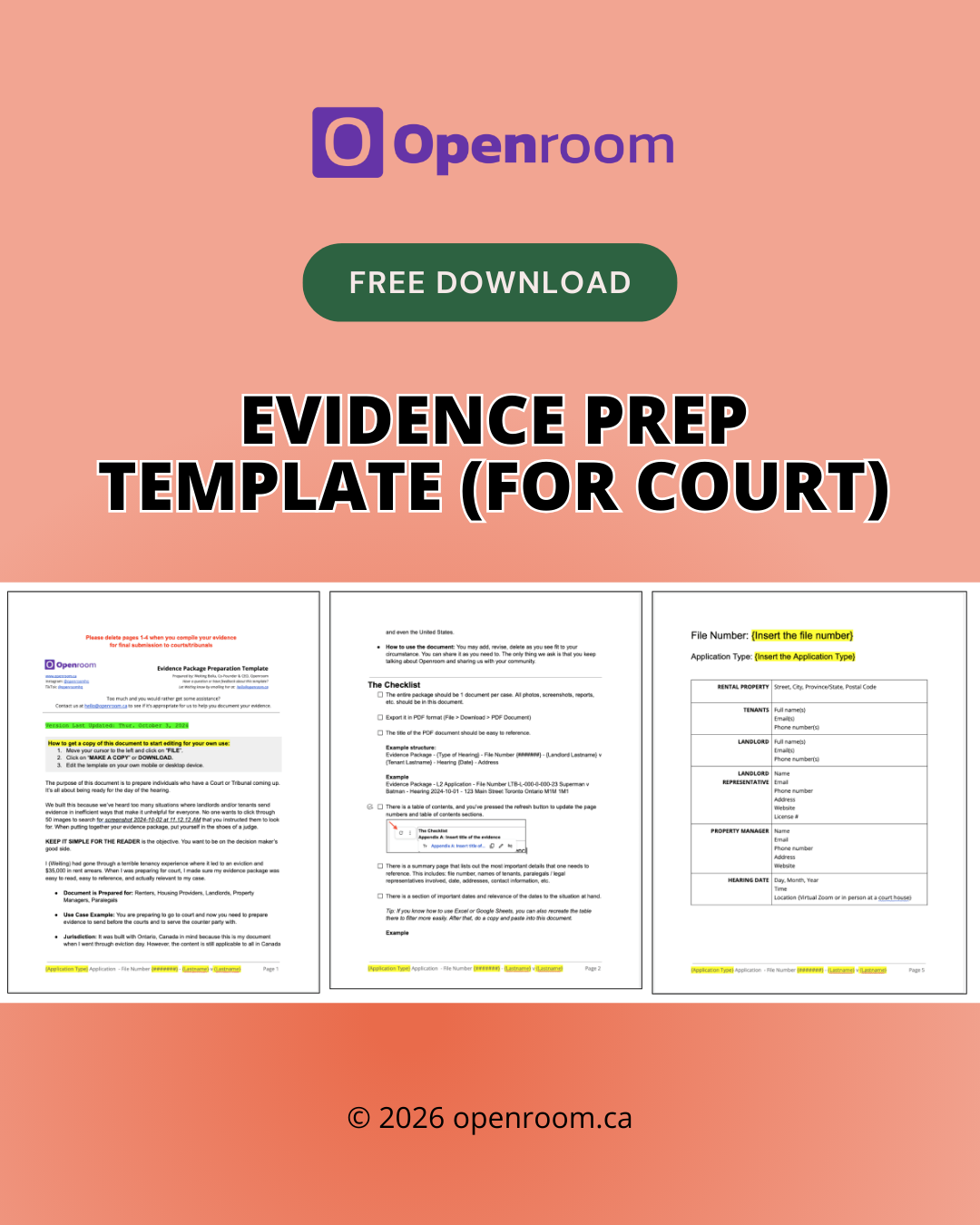
In the case you end up in court, our evidence prep template is a free resource that might be helpful for you.
If you won at the Landlord Tenant Board or Small Claims Court and still haven’t been paid, don’t stop there. Ontario law gives you several enforcement tools - and not all of them are worth using.
If you’ve ever gone through Small Claims Court and actually won your case, or you were able to successfully convert your LTB decision into an order, you probably assumed the hard part was over.
But here’s the reality: Winning doesn’t mean you automatically get paid.
Hello, my name is Weiting, and I’m the CEO of Openroom.ca. I look at court orders and tribunal decisions every single day! One of the top questions I get asked is “How do I enforce money owed to me?”
Today’s video is made in partnership with Courtready.ca, which builds practical tools and lessons for self-represented litigants across Canada.
Once you have an order from the Small Claims Court, there’s a whole separate process for collecting the money. In Ontario, that process is governed by something called Rule 20, and it gives you a few different tools you can use depending on your situation.
Heads up, there are several methods and you might feel overwhelmed. At the end, we’ll share a tool you can use to assess your situation!
Let’s dive in shall we?
One of the most common enforcement options is garnishment.
This is where money is taken directly from the debtor’s wages or their bank account.
When it works, it can be very effective. If someone has steady employment, you can receive money from every paycheque.
But there are real limitations. By law, only 20% of wages can be taken. Bank accounts might be empty. And you need accurate information — like the correct employer or the exact bank branch.
So, garnishment is powerful, but only when you have good information.
Another option is asking a bailiff to seize and sell the debtor’s personal property — things like vehicles, equipment, or business assets.
The advantage is that if someone owns valuable assets, this can work. The bailiff handles the process, not you.
The downside is that many everyday items are legally protected and can’t be seized. Bailiffs also charge fees up front. And even when property is sold, it often sells for less than expected. It’s also possible that the costs to enforce the seizure and sale exceeds how much the debtor owes you.
It’s a tool, but it’s not always the easy solution people imagine.
[Refer to Other Video]
If the debtor owns property, like a house or land, there’s another option: registering your judgment against their property.
This doesn’t mean the house gets sold right away. What it really does is create a legal claim. So when the property is eventually sold or refinanced, you may get paid out of the proceeds.
The benefit is that it’s often effective long-term. The downside is timing. You might wait years. And if there are mortgages or older claims, those usually (but not always) get paid first.
This is more of a patience strategy than a quick recovery strategy.
Sometimes the biggest problem is simple: you don’t know anything about the debtor’s finances.
That’s where an examination of the debtor comes in.
This is a court process where the debtor has to show up and answer questions under oath about their income, bank accounts, assets, and debts.
The upside is that it can give you real, reliable information. Judges can also make payment orders based on what comes out of the examination.
The downside is that it doesn’t directly collect money. And sometimes people don’t show up, which slows things down. But strategically, this is often the smartest first step when you’re in the dark.
[Refer to Other Video.]
In some situations, the debtor owes money to several people, not just you.
The court can issue something called a consolidation order, which creates a structured payment plan where the debtor pays the court, and the court distributes the money among creditors.
The benefit is predictability and fairness. The downside is that you’re sharing payments with others, and the total amount collected each month is still limited.
This option is more common when the debtor is trying to manage multiple debts at once.
The final tool is contempt of court.
This only comes into play if a debtor ignores a court-ordered examination, refuses to answer questions, or fails to produce financial records and documents. A judge can impose penalties, including brief jail time - in extreme cases.
But it’s important to be honest about this: Contempt doesn’t collect money. It exists to force cooperation. It’s serious, and it’s usually a last resort.
As promised, there is a freebie tool! Our friends at Courtready.ca built an interactive tool called “Ontario Small Claims Court Enforcement Options Guide”.
It asks you a few simple questions and then shows you which options make sense for your situation, with clear explanations of the pros, cons, and practical realities.
If you’ve won a Small Claims Court case and you’re not sure what to do next, visit:
https://courtready.ca/how-to-enforce-an-ontario-small-claims-court-judgment/
I love free and helpful resources - if you do too, hit subscribe so I can share more knowledge with you. Let’s learn more together. See you next week!
Disclaimer: The information provided in this article is for general educational and informational purposes only and does not constitute legal, financial, or professional advice. You should consult a qualified professional regarding your specific circumstances before taking any action.
.png)



Weiting's entrepreneurial journey began with a costly lesson in rental property management, where she experienced losses exceeding $35,000 due to non-paying tenants. Determined to prevent others from facing similar challenges, she built Openroom to pave a future towards a transparent and connected rental ecosystem.
Drawing from her extensive background in software product management spanning education, telecommunications, insurance, and artificial intelligence, Weiting has become a trusted advisor to founders of venture-backed companies. Beyond the tech sphere, Weiting managed properties for over a decade and made significant contributions to community leadership. She’s served on the Board of Rotary District 7070 and chaired various organizational committees.
Weiting balances her professional endeavours with being a parent of two kids under two. Alongside thousands of other parents, she was awarded participation trophies in innovative improvisation, ever-changing expectations management, daily roadmap planning, and hardcore patience!


.png)
.png)

.png)
.png)
.png)
.png)

.png)
.png)